
Insulin is a peptide hormone. Human growth hormone is also a peptide/protein hormone. GLP-1–based medications fall within the broader category of peptide-related drugs. At the same time, names such as BPC-157, TB-500, and GHK-Cu are frequently discussed in the context of recovery, tissue repair, anti-aging, and fitness. Even hydrolyzed collagen and protein hydrolysates may be described as peptide-based products.
They may all be referred to as “peptides,” but they differ dramatically in their level of evidence, use cases, regulatory status, risk profile, and professional responsibility.
For athletes, coaches, and sports nutrition professionals in particular, the question cannot stop at: “Does this peptide work?” The more important questions are:
- Is it a food, a dietary supplement, or a drug?
- Has it been adequately studied in humans?
- Has it been approved for human use?
- Could it create anti-doping risks?
- Does its use require medical supervision?
- Have the claims being made for it gone beyond the evidence?
......
These are exactly the kinds of questions Rick Collins will address in GPNi’s June webinar, “Peptides: Regulation and Nutrition.”
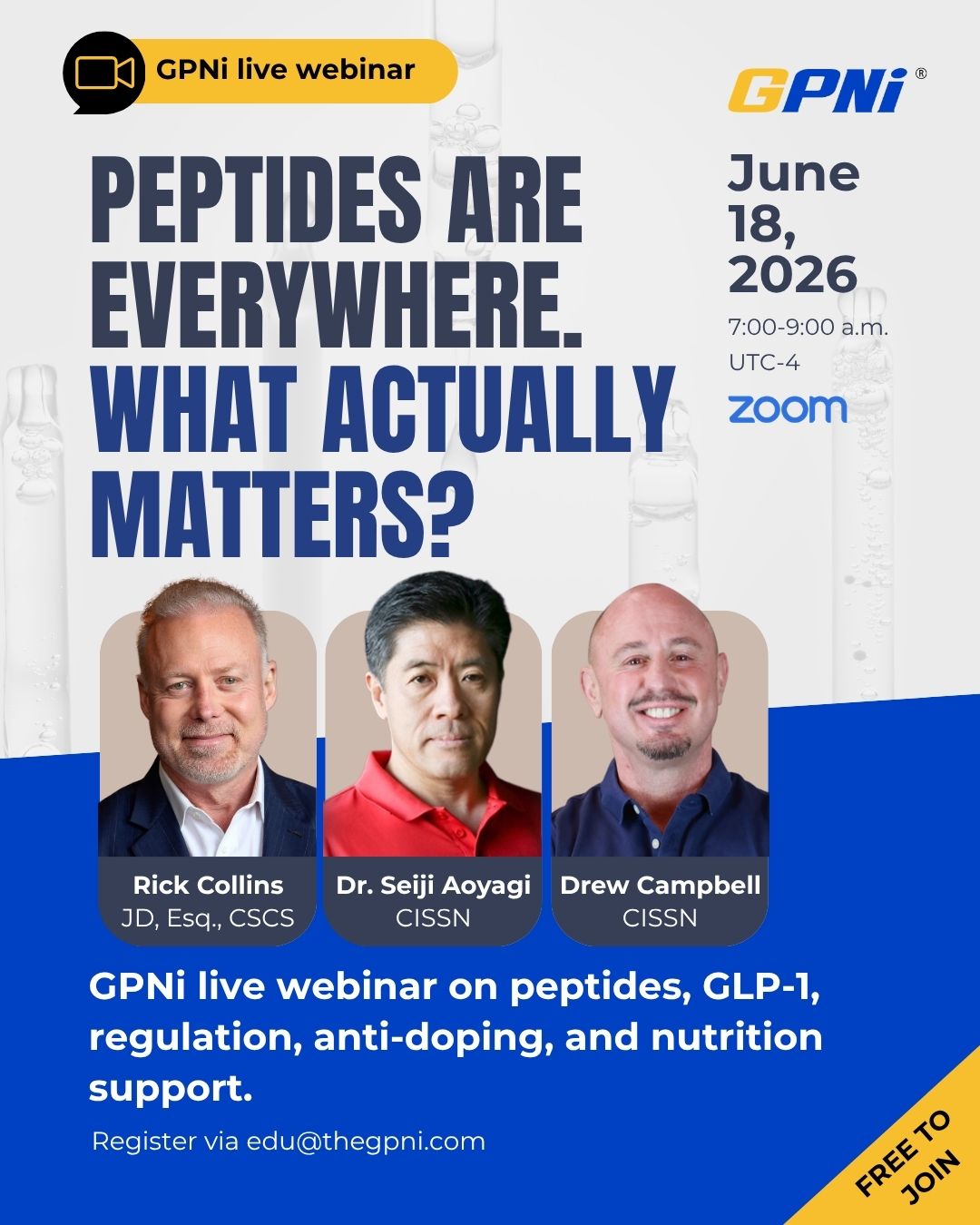
GPNi June Live Webinar: Peptides
Date: June 18, 2026
Time: 7:00 am – 9:00 am, Florida time (UTC-4)
Platform: Live worldwide on Zoom
Cost: Free to attend
CEC: 5
👉 Register here. For any inquiries, please contact edu@thegpni.com.
The webinar will be moderated by Drew Campbell, Co-Founder and CEO of GPNi, and will include expert presentations followed by a roundtable discussion and live audience Q&A. It will be an interactive and in-depth online conversation, designed to encourage open discussion and practical insights. Together, we will explore peptide nutrition, GLP-1-related topics, and nutrition strategies for weight management and overall health support.
Today, let’s take a closer look at Rick’s upcoming presentation on the science, regulation, and market realities of peptides.
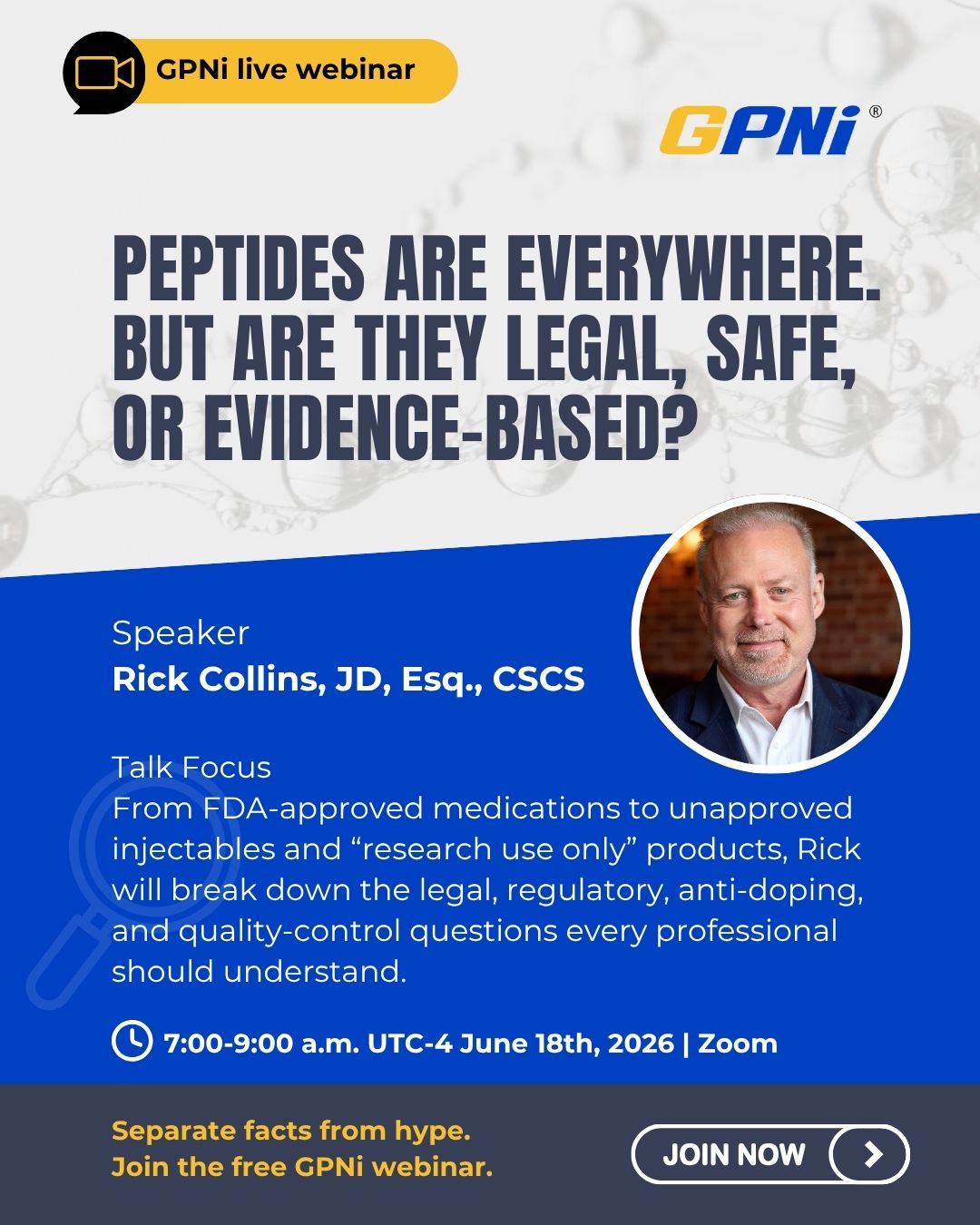
Rick Collins, JD, Esq., CSCS
Rick Collins is internationally recognized as one of the leading legal authorities in the dietary supplement and sports nutrition space. He is a partner at Collins Gann McCloskey & Barry PLLC, longtime General Counsel to the ISSN, and official legal advisor to the IFBB Pro League.
Rick brings an unusual combination of experience to this topic. He works at the intersection of law, regulation, sport, and the supplement industry. He is also an NSCA Certified Strength and Conditioning Specialist (CSCS), a former personal trainer, and a former competitive bodybuilder. Over the years, he has taught and spoken widely on dietary supplements, sports nutrition, and industry compliance, contributed chapters to textbooks, and written for major health and fitness publications, including as a columnist for Muscular Development.
His Talk: A Deep Dive into the Peptide Revolution
From a biological perspective, peptides are short chains of amino acids linked by chemical bonds that can deliver specific signals or “instructions” in the body. But in the real-world marketplace, the word “peptide” covers far more than many people realize. A peptide may be an FDA-approved prescription drug, a compound still being studied in clinical trials, an injectable product offered through wellness clinics or compounding pharmacies, a product sold online by “research chemical” websites, or simply a conventional nutrition product.
That is why the real danger is not failing to recognize the name of one popular peptide. The real danger is treating completely different categories of products as if they were the same thing.
Peptides: Not Pseudoscience, But Not a Cure-All Either
Peptide drug development has a long history. Since the introduction of insulin, many peptide-based drugs have entered clinical use and have been applied in areas such as diabetes, cancer, osteoporosis, multiple sclerosis, HIV infection, and chronic pain. In recent years, advances in peptide production, modification, delivery, and analysis have continued to make therapeutic peptides an active and important area of drug development.
So peptides are not “unscientific.” The real issue is that, in the marketplace, many claims about peptides often blur the line between science, commercial promotion, personal experience, and gray-market marketing.
GLP-1–based medications are a good example. They have attracted enormous attention because they have genuinely changed the conversation around weight management. But they are, first and foremost, prescription medications with defined patient populations, conditions of use, and requirements for medical supervision. They are not ordinary weight-loss products that can simply be copied or used casually.
In addition, peptide products such as BPC-157 and TB-500, often promoted as “healing peptides,” and GHK-Cu, often promoted for skin rejuvenation, are frequently discussed in the U.S. and other international markets through wellness clinics, compounding pharmacies, online “research chemical” websites, and the fitness and anti-aging space.
But the fact that something is being promoted, sold, or discussed in the marketplace does not mean it has been approved for human use. Nor does it mean it can be used safely or compliantly by athletes. On the contrary, the FDA has raised concerns around certain compounded peptide-related substances, including BPC-157, injectable GHK-Cu, and TB-500, including concerns related to safety, immunogenicity, peptide-related impurities, and insufficient human safety data.
This is why we need to recognize that when a “peptide” has strong biological activity, it often belongs closer to the world of drugs and medical management than to the world of casual health optimization outside regulatory and professional supervision.
“Research Purposes Only” Is a Warning Sign
Rick will also draw attention to a common label in this space: “research purposes only” or “not for human use.”
Many online “research chemical” websites sell injectable peptide products using these disclaimers. On the surface, the label may look like a form of legal protection for the seller. In reality, however, these products are often interpreted and used by consumers in the context of recovery, fat loss, anti-aging, skin health, and health optimization.
For consumers and practitioners, these labels should raise red flags, not increase confidence. If a product is explicitly labeled “not for human use,” yet is repeatedly discussed in fitness, recovery, fat-loss, or anti-aging contexts, the key question is not “How did someone feel after using it?” The real questions are: Is the source reliable? Are purity and dosage controlled? Has it been independently tested? Could it be contaminated or contain undeclared ingredients? Is the seller trying to avoid responsibility? Does the user truly understand the risk?

Anti-Doping Risk: Athletes Cannot Ignore This
For drug-tested athletes, physique competitors, combat sport athletes, bodybuilders, or anyone subject to anti-doping rules, peptides are never just a question of “Do they work?”
Certain peptide hormones, growth factors, releasing factors, and related mimetics may fall under anti-doping rules. Products from unclear or unreliable sources may also carry risks of contamination or undeclared ingredients.
No matter how compelling a substance sounds on social media, it cannot replace proper rule interpretation, product verification, and professional responsibility.
More Than Regulation: Understanding the Entire Peptide Market
The core value of Rick Collins’ presentation is not to reduce peptides to “good” or “bad.” Instead, he will provide a legal, market, and real-world overview of the full peptide landscape.
He will not simply evaluate one peptide in isolation. He will help participants understand the broader ecosystem: prescription peptide drugs, investigational compounds, wellness clinic services, compounding pharmacies, online “research chemical” sites, the dietary supplement market, and social media — and how all of these forces have contributed to making peptides one of the hottest topics in fitness, weight management, recovery, and health optimization.
Rick will address key questions such as:
- Where do peptides fall within the regulatory framework for foods and drugs?
- What is driving their explosive popularity?
- Are health practitioners currently allowed to prescribe them to patients?
- Can consumers legally possess them without a prescription?
- What problems can arise when these products are sold as “not for human use” research products?
- What is their status under anti-doping rules in drug-tested sports?
- How much solid science supports their safety, efficacy, and the claims being made for them?
- What quality-control assurances can buyers realistically expect?
- How much of the risk depends on the source of the product?
- Where is the FDA likely headed on this issue?
- And how do we balance the government’s role in consumer protection with the personal health freedoms of responsible adults?
Who Should Attend?
If you are a sports nutritionist, coach, or fitness professional, this webinar will help you build a stronger professional framework for understanding peptides.
If you are personally interested in body composition, recovery, and health optimization, it will help you separate what is genuinely useful from what is mostly market noise.
And for many people outside North America, this webinar carries an additional benefit. Peptides may already be a high-profile topic overseas, but there are still relatively few discussions that are structured, evidence-based, and practical. This is a chance to build your framework early, before the topic gets even louder.
GPNi is also exploring Zoom’s live captioning and translated caption options to make the event more accessible for a global audience. Depending on platform availability and event settings, this may include real-time subtitles and translated captions in multiple languages, potentially including Japanese, French, and others.
GPNi June Webinar: Hear Rick Collins Break Down the Peptide Revolution
Rick Collins will deliver a featured presentation in GPNi’s June webinar:
A Deep Dive into Peptides: Separating Facts, Regulation, and Bro-Science
Date: June 18, 2026
Platform: Live worldwide on Zoom
Cost: Free to attend
CEC: 5
👉 Register here. For any inquiries, please contact edu@thegpni.com.











 Instagram
 Facebook
 YouTube
 Twitter
 Linkedin