
The “before and after” side of GLP-1 therapy is easy to find.
Open TikTok, Instagram or YouTube and you will see dramatic weight-loss transformations linked to medications such as semaglutide and tirzepatide. What gets much less attention is what happens later.
What happens when appetite suppression fades? What if treatment is reduced or stopped? How do you maintain the progress you have made? And from a performance nutrition perspective, what happens to diet quality, muscle, strength and the ability to exercise along the way?
These questions are becoming increasingly relevant as GLP-1–based medications become a mainstream part of obesity care.
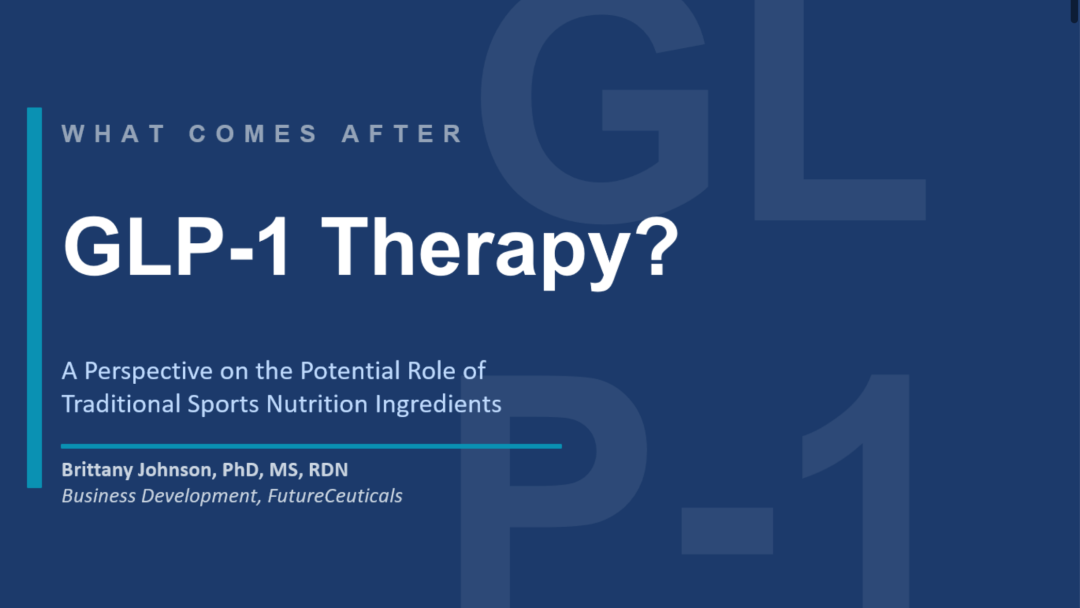
At the 2026 ISSN Conference, Brittany Johnson, PhD, RDN, explored GLP-1 therapy through a sports nutrition lens, including the challenges of maintaining weight loss, protecting lean tissue and supporting people as they become—or return to being—more physically active. The official ISSN programme describes her presentation as examining opportunities for sports nutrition to support lean mass, exercise endurance, strength and recovery in the GLP-1 era.
Before getting into the supplements, however, there is a more important point: the strongest foundation is still nutrition, exercise and appropriate medical care.
Johnson is now with FutureCeuticals, a nutritional ingredient company, so the industry context of supplement-related ideas is worth keeping in mind. Some of the concepts discussed are scientifically plausible and supported in other populations, but that is not the same as having direct clinical evidence in people using—or discontinuing—GLP-1 medications.
That distinction matters.
Stopping treatment changes the equation
GLP-1–based therapies can make weight management easier partly by reducing appetite, increasing satiety and altering gastrointestinal function. But when treatment stops, those effects do not necessarily remain.
The STEP 1 extension gives us one of the clearest examples. Participants receiving semaglutide lost an average of 17.3% of body weight over 68 weeks. One year after treatment was withdrawn, they had regained 11.6 percentage points—approximately two-thirds of the weight they had previously lost. Several cardiometabolic improvements also moved back toward baseline.
The pattern is not unique to semaglutide.
In SURMOUNT-4, participants first received tirzepatide for 36 weeks and lost substantial weight. Those who continued treatment for another 52 weeks lost an additional 5.5%, while those switched to placebo regained approximately 14%.
A 2026 BMJ systematic review broadened the picture. Across weight-management medications, average regain after discontinuation was approximately 0.4 kg per month, with modelling suggesting a return toward baseline body weight in roughly 1.7 years on average. Importantly, these are population averages and projections—not a prediction of what will happen to every individual.
None of this means GLP-1 medications “do not work.”
Quite the opposite.
It reminds us that obesity is a chronic, complex condition. If a medication is helping control one of the biological drivers of weight, removing that treatment can make weight management harder again.
That is also why decisions about continuing, tapering or stopping medication belong between the individual and their healthcare provider—not with an influencer, a supplement company or a number on the scale.
Eating less does not automatically mean eating better
Reduced appetite can be powerful for weight loss. But there is a nutritional trade-off that deserves more attention.
When someone is eating much less food, every meal has to work harder.
Johnson and colleagues studied 69 adults using GLP-1 receptor agonists for weight reduction. Their three-day food records showed inadequate average intakes of several nutrients, including fiber, calcium, iron, magnesium, potassium and vitamins A, C, D and E. Average fiber intake was only 14.5 g/day, and participants were not meeting recommended servings for several major food groups.
A secondary analysis of the same population produced an average Healthy Eating Index score of 54 out of 100, with particularly weak intakes of fruit, vegetables, whole grains, dairy, seafood and plant proteins.
Protein is another useful example.
Someone may obtain a reasonable percentage of their calories from protein while still consuming too little protein in absolute terms because total food intake has fallen so much. Johnson's research found that protein intake expressed relative to body weight was below proposed needs for preserving lean tissue during energy restriction.
This changes the practical question.
Instead of asking only:
“How few calories am I eating?”
it may be more useful to ask:
“What am I getting from the food I can comfortably eat?”
Is there a meaningful protein source at each meal? Are fruits and vegetables disappearing? Is fiber consistently low? Are dairy or other calcium-rich foods being displaced? Is the person eating so little that basic nutritional adequacy is becoming difficult?
When appetite is low, nutrition density becomes more important—not less.
Weight loss is not the only outcome worth protecting
People understandably focus on fat loss when using weight-management medication.
But meaningful weight loss generally involves some loss of fat-free tissue as well.
In an exploratory DXA substudy of STEP 1, semaglutide reduced total fat mass by 19.3% and visceral fat mass by 27.4%, while measured lean body mass declined by 9.7%. Because fat mass fell more substantially, lean mass actually represented a larger proportion of total body weight after treatment.
That nuance is important.
A 9.7% reduction in DXA-measured lean mass does not mean someone lost 9.7% of their skeletal muscle. “Lean mass” includes water and other non-fat tissues. Nor is lean-tissue loss unique to GLP-1 therapy; it is commonly seen during substantial energy restriction and weight loss.
Still, from a performance nutrition perspective, we should care about more than the ratio of fat to lean tissue.
Can the person still get out of a chair easily?
Are they maintaining strength?
Are they becoming more physically active—or less?
Can they complete resistance training?
Are fatigue, low energy intake or gastrointestinal symptoms making exercise increasingly difficult?
Those questions may tell us more about long-term physical capacity than body weight alone.
Protein matters. Resistance training matters more than protein alone.
A major 2025 joint advisory from the American Society for Nutrition, The Obesity Society, the Obesity Medicine Association and the American College of Lifestyle Medicine emphasized adequate protein and structured resistance training as priorities during GLP-1 treatment.
Higher protein intakes are often proposed during active weight reduction—commonly around 1.2–1.6 g/kg/day in relevant literature—but prescribing protein from actual body weight becomes complicated in people with obesity and may substantially overestimate requirements. The advisory therefore discusses approaches based on adjusted body weight, fat-free mass or practical absolute targets rather than pretending one equation works for everybody.
That is a good example of where professional nutrition differs from social-media nutrition.
“Eat 150 grams of protein” is easy to post.
Determining whether that is appropriate for a particular person requires considerably more context.
And protein is only half of the equation.
Muscle needs a reason to stay.
Resistance training provides that stimulus. The same advisory notes that simply increasing protein without structured strength training is unlikely to be an optimal strategy for preserving muscle during substantial weight reduction. Mixed programmes that combine resistance and aerobic exercise make much more sense for long-term metabolic health, fitness and physical function.
Where does sports nutrition fit?
This is where Johnson's ISSN presentation becomes particularly interesting.
As GLP-1 users lose substantial weight and become more active, many begin encountering familiar sports nutrition problems:
“I want to train, but I feel tired.”
“I'm eating much less—how do I get enough protein?”
“My strength is down.”
“Training suddenly feels harder than it used to.”
“How do I recover when I struggle to eat?”
Traditional sports nutrition has tools that address each of these problems.
But we need to separate evidence for the ingredient from evidence for the GLP-1 population.
Supporting training readiness
Caffeine, beta-alanine and dietary nitrate all have established bodies of evidence in sport, but for different outcomes and different exercise demands.
That does not make them treatments for GLP-1-related fatigue.
Caffeine may improve alertness or exercise performance in appropriate situations, but sleep, tolerance and cardiovascular considerations still matter. Beta-alanine has specific applications for high-intensity exercise rather than being a general energy supplement. Nitrate may support exercise economy and blood flow in some settings, with responses varying by training status and sport.
If someone taking a GLP-1 medication is tired because they are chronically under-fuelled, however, adding stimulants without correcting the underlying energy and nutrient problem is unlikely to be the smartest first move.
Supporting muscle and training
Protein supplements can be genuinely useful when reduced appetite makes normal meals difficult.
They provide a relatively low-volume way to increase protein intake, which is why the 2025 joint advisory also recognises protein shakes, bars and fortified foods as practical options for some people.
Creatine is another logical ingredient to discuss because of its extensive evidence for strength and training adaptations in exercising populations.
But “logical” is not the same as “proven after GLP-1 discontinuation.”
The same caution applies to essential amino acids and HMB. There may be situations in which these tools are relevant—particularly when dietary intake is restricted or muscle-loss risk is elevated—but the overall programme still matters more than the ingredient list.
Supporting recovery
Omega-3 fatty acids, tart cherry and curcumin have all been studied in broader exercise and recovery contexts.
Again, that does not automatically make them GLP-1 recovery supplements.
If someone has severe muscle soreness because they went from almost no exercise to five hard sessions in one week, the priority may be better programming.
If recovery is poor because energy intake is extremely low, the priority may be nutrition.
If sleep is inadequate, no “recovery stack” removes the need to sleep.
This is where good performance nutrition keeps supplements in their proper place.
They can solve specific problems.
They should not be used to distract from larger ones.
There is no validated “post-GLP-1 supplement stack”
This may be the most important scientific qualification in the entire discussion.
Research specifically testing traditional sports supplements in people during or after GLP-1 treatment remains limited. A 2025 narrative review led by Johnson noted that GLP-1-specific nutrition science is still emerging and that much of the proposed supplementation strategy has to be extrapolated from studies of obesity, energy restriction and other populations.
That is useful for generating hypotheses.
It is not enough to declare a clinically validated protocol.
So combinations such as creatine plus protein, caffeine plus nitrate, or recovery-focused ingredients may be interesting directions for future research—but they should not be presented as proven methods for preventing weight regain after stopping medication.
The evidence simply is not there yet.
The best time to prepare for “after GLP-1” may be before it happens
It is tempting to treat discontinuation as the point at which lifestyle suddenly becomes important.
That is probably too late.
The period when appetite is better controlled may actually be an opportunity to build the behaviours that will matter later:
Learn how to structure meals around nutrient-dense foods.
Find protein sources that are easy to tolerate.
Build a resistance-training routine.
Improve aerobic fitness.
Learn what hunger feels like at different activity levels.
Develop meals that are satisfying without depending entirely on appetite suppression.
Work on sleep, stress and food environment.
Practice the lifestyle you hope to maintain.
This does not guarantee that weight will never return after medication stops. The biological changes involved are more complicated than that, and some people may require long-term pharmacotherapy.
But lifestyle gives the individual more tools to work with—whether medication continues or not.
GPNi Practical Takeaways
For coaches, nutrition professionals and active individuals, the conversation after GLP-1 weight loss should extend well beyond the scale.
Start during treatment, not after it. Nutrition habits, resistance training and regular physical activity should ideally develop while weight is coming down.
Prioritize diet quality before supplements. When total food intake is low, protein, fruits, vegetables, whole grains and key micronutrient sources become particularly important.
Track function as well as weight. Waist circumference and body composition may be useful, but strength, training capacity, daily movement, fatigue and recovery tell another part of the story.
Combine aerobic and resistance exercise. Cardiorespiratory fitness matters, but resistance training provides a particularly important stimulus for maintaining strength and functional lean tissue during weight loss.
Use sports nutrition for a reason. Protein supplements, creatine and established ergogenic aids may have a place when they address a defined need. They are not a substitute for adequate food, progressive training or medical care.
Do not turn emerging science into a “GLP-1 stack.” There are currently important gaps in direct clinical evidence for supplementation specifically during or after GLP-1 therapy.
And finally:
Stopping medication is a medical decision.
Whether treatment should continue, change or stop should be decided with an appropriately qualified healthcare professional.
The real work of maintaining the benefits of weight loss does not suddenly begin when the prescription ends.
It starts while the weight is coming off—by protecting nutrition, strength and the capacity to keep moving.
Want to explore the full ISSN presentation?
GPNi Members can access professional sports nutrition resources and selected presentation materials from ISSN conferences through the GPNi platform.
Become a GPNi Member to explore the science behind emerging topics in performance nutrition and stay connected with current research and professional practice.










 Instagram
 Facebook
 YouTube
 Twitter
 Linkedin