
Which term refers to the reference amounts used on Nutrition Facts and Supplement Facts labels to show how much a nutrient in one serving contributes to a person’s total daily diet?
A. Recommended Dietary Allowances
B. Tolerable Upper Intake Levels
C. Daily Values
D. Acceptable Macronutrient Distribution Ranges
Correct Answer: C. Daily Values
Pick up a protein bar, sports drink or multivitamin and you will probably see percentages listed beside several nutrients.
A product might provide 30% of the Daily Value for iron, 20% for calcium or 40% for sodium. These numbers can be useful, but they are often misunderstood—especially in sports nutrition.
A Daily Value is not a personalised target. It does not know how much an athlete weighs, how long they train, how heavily they sweat or whether they are preparing for a marathon, a strength competition or a rest day.
For athletes and coaches, the Daily Value is best treated as a label-reading tool rather than a complete nutrition prescription.
What Is a Daily Value?
Daily Values, usually shortened to DVs, are reference amounts used on Nutrition Facts and Supplement Facts labels in the United States.
The Percent Daily Value tells you how much one serving of a product contributes to the Daily Value for a particular nutrient. For example, a product containing 230 milligrams of sodium would provide 10% of the current 2,300-milligram Daily Value for sodium.
As a general label-reading guide:
- 5% DV or less per serving is considered low.
- 20% DV or more per serving is considered high.
This makes %DV useful when comparing similar products. An athlete looking for an iron-rich cereal, for example, can quickly see which option provides more iron per serving. Someone trying to reduce added sugar can use the same system to compare products.
Other countries use their own reference-intake or nutrient-reference systems, so the terminology and exact values may differ. The principle is similar: the number provides context for the amount listed on the label.
Daily Values Are Not the Same as Individual Requirements
Recommended Dietary Allowances, Adequate Intakes and other Dietary Reference Intakes are developed for different age and sex groups. Daily Values work differently.
One Daily Value is selected for use on most adult food and supplement labels. It is designed to make products easier to compare, not to provide an exact requirement for every person. A DV may be similar to an individual’s RDA or AI, but it is not always the same.
This distinction becomes particularly important in sports nutrition because exercise can substantially change energy, carbohydrate, protein, fluid and electrolyte needs.
Protein: Why 100% DV May Still Not Be Enough
The current Daily Value for protein is 50 grams.
That amount may be reasonable as a general labelling reference, but it is not an appropriate performance target for every athlete. The International Society of Sports Nutrition states that approximately 1.4–2.0 grams of protein per kilogram of body weight per day is sufficient for most exercising individuals seeking to build or maintain muscle.
For a 75-kilogram athlete, that range equals approximately 105–150 grams per day.
This athlete could consume 200% of the protein Daily Value and still be within a normal evidence-based sports nutrition range. The percentage looks high only because it is being compared with a general labelling reference rather than an individual, weight-based target.
There is another detail worth knowing: a protein %DV is not required on every food label. For products intended for the general population, it is generally required when a specific protein claim—such as “high in protein”—is made. The number of protein grams may still appear even when no percentage is shown.
Athletes should therefore focus on the grams of protein, serving size, protein quality and total daily intake rather than judging a product by %DV alone.
Carbohydrate: Training Demand Changes the Picture
The Daily Value for total carbohydrate is 275 grams, based on the general 2,000-calorie reference diet used for nutrition labelling.
Again, this is not a universal sports nutrition target.
For a 70-kilogram athlete, 275 grams equals just under 4 grams per kilogram. That may be adequate on a light training day for some people, but it may be too little during a high-volume endurance block, tournament schedule or demanding competition period.
Athletes are generally advised to adjust carbohydrate intake according to the intensity, duration and purpose of their training. Carbohydrate availability can be increased through intake before exercise, during longer sessions and throughout recovery. During prolonged exercise, common evidence-based targets include approximately 30–60 grams per hour, with higher intakes sometimes used in longer endurance events.
This means that a food providing 20% of the carbohydrate DV is neither automatically high nor low for an athlete. Its value depends on when it is eaten and what the athlete is preparing to do.
A carbohydrate-rich drink may be unnecessary during a short, easy session. The same drink may be useful during a long ride, a tournament or rapid recovery between two training sessions.
Context matters more than the percentage alone.
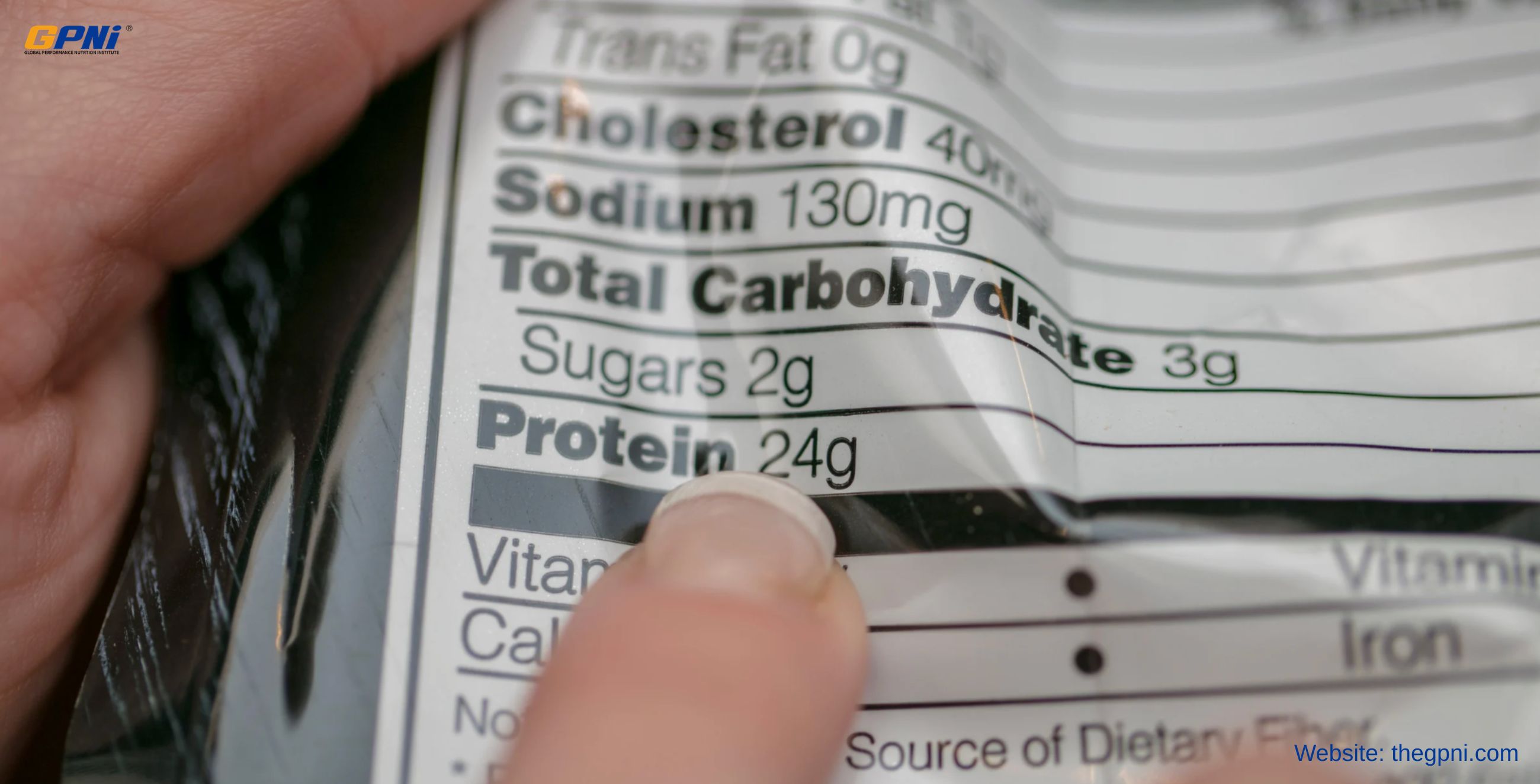
Sodium: A Limit on the Label, but Also an Exercise Variable
Sodium provides another good example of why label values require interpretation.
The Daily Value for sodium is 2,300 milligrams, and the general public-health advice is to remain below this amount. A food containing 20% or more of the DV per serving is therefore considered high in sodium.
For everyday meals, this remains useful information. Athletes are not automatically protected from the health concerns associated with a chronically poor-quality, high-sodium diet.
However, sodium is also the main electrolyte lost through sweat. Sweat rate and sweat sodium concentration vary widely between athletes and can change with exercise intensity, environment and acclimatisation. Fluid and electrolyte replacement should therefore be individualised.
A sports drink containing 15% of the sodium DV may look relatively high when judged as an ordinary beverage. During a long session in hot conditions, however, that sodium may serve a practical purpose.
The key is to separate everyday dietary intake from exercise-specific replacement. Athletes should not use heavy sweating as a reason to ignore sodium intake completely, nor should they avoid all sodium during prolonged exercise simply because the label percentage appears high.
Micronutrients: More Than 100% Is Not Always Better
Daily Values are especially visible on multivitamins and fortified sports products.
A supplement may contain 100%, 300% or even 1,000% of the DV for certain vitamins. Large percentages can make a product look powerful, but they do not prove that it improves performance.
Athletes should first ask whether a deficiency, inadequate intake or increased risk has been identified.
Iron is a good example. It supports haemoglobin and oxygen transport, and low iron status can be relevant to health and exercise performance. Requirements also vary according to age, sex, menstrual blood loss and dietary pattern.
However, an iron value on a label cannot diagnose iron deficiency. An athlete experiencing persistent fatigue should not simply choose the supplement with the highest %DV. Iron status should be assessed properly, and unnecessary high-dose supplementation should be avoided because too much iron can also be harmful.
The same general principle applies to vitamin D, calcium, magnesium and other micronutrients. The label helps quantify what the product contains. It does not establish whether the athlete needs it.
Serving Size Can Change Everything
Before looking at the %DV, always check the serving size.
All calories, nutrient amounts and percentages on the label are based on the stated serving. If a bottle contains two servings and the athlete drinks the whole bottle, every value must be doubled.
A product containing 300 milligrams of sodium and 25 grams of carbohydrate per serving provides 600 milligrams of sodium and 50 grams of carbohydrate when two servings are consumed.
This sounds obvious, yet serving-size errors are common with sports drinks, recovery products, powders and snack foods. The amount an athlete actually consumes matters more than the front-of-package claim. The FDA also emphasises that a listed serving size reflects the amount people typically consume; it is not necessarily a recommendation of how much an individual should eat.
How Athletes Should Use %DV
Daily Values still have a useful role in sports nutrition.
They can help athletes compare similar products, identify foods that contribute useful micronutrients and notice when a serving is particularly high in sodium, added sugars or saturated fat.
But the label should be read in two stages.
First, use it as a general comparison tool. Check the serving size, grams or milligrams, ingredients and %DV.
Then interpret those numbers within the athlete’s actual needs. Consider body mass, training load, competition schedule, sweat losses, dietary restrictions, health status and the timing of intake.
A high %DV is not automatically good or bad. A low %DV is not automatically inadequate. The meaning depends on the nutrient and the situation.
The Bottom Line
Daily Values answer a useful question:
How much does one serving of this product contribute to a standard daily reference amount?
They do not answer a more individual question:
How much of this nutrient does this athlete need for health, training and performance?
For that, athletes need evidence-based targets that account for body size, sport, training volume, recovery demands and individual health.
Use the Daily Value to understand the label. Do not use it as the entire nutrition plan.
References
- U.S. Food and Drug Administration. Daily Value on the Nutrition and Supplement Facts Labels. FDA.
- U.S. Food and Drug Administration. How to Understand and Use the Nutrition Facts Label. FDA.
- National Institutes of Health, Office of Dietary Supplements. Daily Values. NIH.
- National Institutes of Health, Office of Dietary Supplements. Nutrient Recommendations and Databases. NIH.
- Jäger R, Kerksick CM, Campbell BI, et al. International Society of Sports Nutrition position stand: protein and exercise. Journal of the International Society of Sports Nutrition. 2017;14:20.
- Thomas DT, Erdman KA, Burke LM. Position of the Academy of Nutrition and Dietetics, Dietitians of Canada, and the American College of Sports Medicine: nutrition and athletic performance. Medicine & Science in Sports & Exercise. 2016;48(3):543–568.
- Burke LM, Hawley JA, Wong SHS, Jeukendrup AE. Carbohydrates for training and competition. Journal of Sports Sciences. 2011;29(Suppl 1)–S27.
- Sawka MN, Burke LM, Eichner ER, Maughan RJ, Montain SJ, Stachenfeld NS. American College of Sports Medicine position stand: exercise and fluid replacement. Medicine & Science in Sports & Exercise. 2007;39(2):377–390.
- National Institutes of Health, Office of Dietary Supplements. Iron: Fact Sheet for Health Professionals. NIH.














 Instagram
 Facebook
 YouTube
 Twitter
 Linkedin