Creatine and beta-alanine are two of the most researched supplements in sports nutrition. They are often included in the same pre-workout formula, and the reasoning appears straightforward: if each supports high-intensity exercise through a different mechanism, taking them together should produce a greater effect.
But physiology does not always add up so neatly.
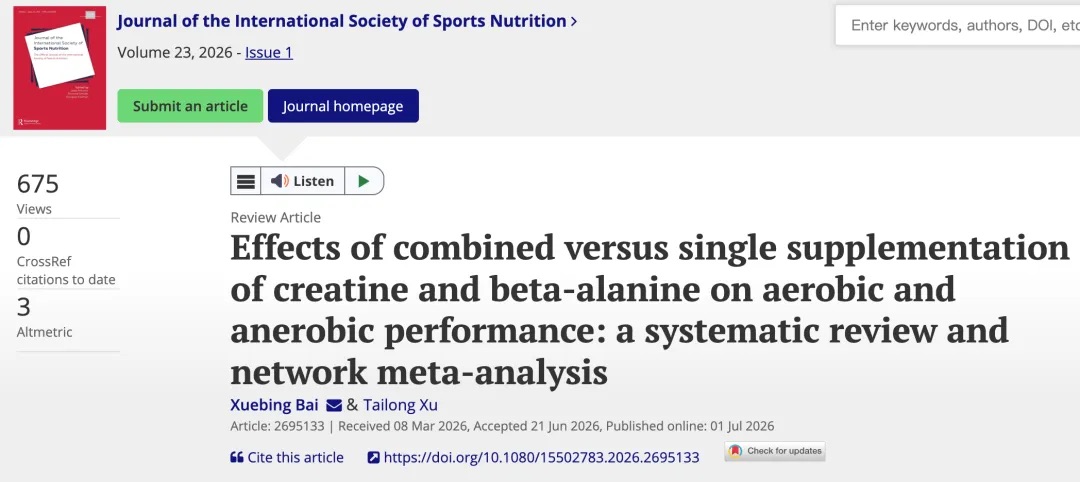
A new systematic review and network meta-analysis published in the Journal of the International Society of Sports Nutrition compared creatine, beta-alanine, their combination, and placebo across a range of aerobic and anaerobic performance outcomes. The researchers wanted to know whether combining the two supplements produced benefits beyond using either one alone.
Overall, creatine produced the most consistent improvements. Beta-alanine showed more limited or context-dependent effects, while the combined strategy did not demonstrate a clear additional advantage over creatine alone.
Why Combining Them Makes Sense in Theory
Creatine and beta-alanine support performance in different ways.
Creatine increases muscle creatine and phosphocreatine availability. During short, intense efforts, phosphocreatine helps regenerate ATP—the immediate source of energy for muscular contraction. Greater phosphocreatine availability may therefore help athletes produce or maintain power during sprinting, jumping, resistance training, and repeated high-intensity efforts.
Beta-alanine works through a different pathway. It increases muscle carnosine, which contributes to intracellular buffering. During intense exercise, hydrogen ions accumulate as the rate of glycolysis rises. This contributes to a decline in muscle pH and may eventually impair force production. By increasing carnosine, beta-alanine may help delay fatigue when acidosis is an important limiting factor.
Theoretically, the combination should cover two different performance demands: creatine supports rapid ATP regeneration, while beta-alanine improves buffering capacity. The question is whether this mechanistic complementarity leads to a meaningful performance advantage in practice.
What Did the Study Find?
The researchers reviewed randomized controlled trials involving healthy adult athletes. Eligible studies examined creatine, beta-alanine, or combined supplementation for at least two weeks. In total, 52 trials met the inclusion criteria.
Rather than relying only on direct head-to-head trials, the researchers used a network meta-analysis. This method combines direct and indirect evidence across several interventions. For example, results from creatine-versus-placebo studies can be considered alongside studies comparing creatine plus beta-alanine with placebo. This makes it possible to estimate the relative performance of different strategies, even when direct comparisons are limited.
The analysis examined sprinting, jumping, agility, repeated-sprint ability, and upper- and lower-body muscular endurance.
Creatine alone significantly improved sprint performance, jump performance, repeated-sprint ability, and upper-body muscular endurance compared with placebo. It also ranked highly across these outcomes, giving it the most convincing overall performance profile of the interventions assessed.
These findings are physiologically plausible. Sprinting, jumping, and repeated high-intensity work all rely heavily on rapid ATP turnover. Increasing phosphocreatine availability may help support peak output and improve recovery between brief efforts.
Creatine did not significantly improve agility or lower-body muscular endurance. This is an important reminder that no supplement improves every component of performance. Agility is influenced by technique, coordination, perception, decision-making, braking ability, and change-of-direction skill—not simply energy availability. Muscular-endurance outcomes also depend on the exercise selected, load, repetition range, training status, and testing protocol.
Why Did Beta-Alanine Appear Less Effective?
Beta-alanine produced nonsignificant or inconsistent effects across the outcomes included in the analysis. This does not necessarily mean it is ineffective. Its benefits are highly dependent on the type and duration of exercise being tested.
A single jump or very short sprint may end before muscle acidity becomes a major limiting factor. In those situations, additional buffering capacity has little opportunity to influence performance. Beta-alanine is more likely to be useful during sustained high-intensity efforts lasting approximately one to several minutes, repeated hard intervals, longer resistance-training sets, or sports involving repeated high-intensity exchanges with incomplete recovery.
The supplementation period may also have influenced the results. Beta-alanine does not work as an acute pre-workout ingredient. Its effect depends on gradually increasing muscle carnosine, which generally requires several weeks of consistent intake. Because this analysis included studies lasting as little as two weeks, some interventions may not have provided enough time or total beta-alanine to maximize carnosine loading.
Creatine can increase muscle stores more quickly, particularly when a loading protocol is used. Part of the difference between the two supplements may therefore reflect how rapidly they take effect and how closely the selected performance tests match their mechanisms.
Why Was the Combination Not Better?
The combined creatine and beta-alanine strategy did not show clear synergistic benefits.
One possible explanation is that creatine already addressed the primary limitation in many of the tests included. If rapid ATP regeneration is the dominant factor in a short sprint or explosive movement, adding more buffering capacity may not produce a detectable improvement.
Similarly, beta-alanine is unlikely to add much when the exercise is too brief to generate substantial acidosis. Two mechanisms may be complementary in theory, but both must be relevant to the task before an additive effect can appear.
The combined evidence base is also smaller and less standardized than the broader creatine literature. Studies differed in supplementation dose and duration, participants, training status, and performance testing. A lack of statistical superiority should therefore not be interpreted as proof that the supplements interfere with one another.
The analysis did not show that combining creatine and beta-alanine reduces performance. It showed that the combination did not consistently outperform creatine alone across the outcomes studied. That is a more precise—and more useful—interpretation.
Interestingly, a 2025 systematic review reached a somewhat more favorable conclusion about co-supplementation, suggesting potential benefits for some measures of high-intensity and repeated-bout performance. However, that review included only seven trials and similarly found no consistent additional benefit for maximal strength or aerobic capacity. Taken together, the evidence suggests that any advantage of combining the supplements is likely to be task-specific rather than universal.

What About Aerobic Performance?
Neither supplement should be viewed primarily as an aerobic-performance enhancer.
Creatine may help endurance athletes improve resistance training, repeated surges, sprint finishes, or high-intensity interval sessions, but it is not expected to directly increase maximal aerobic capacity. The small increase in body mass that often accompanies creatine loading may also matter in weight-bearing endurance events.
Beta-alanine may be relevant when an endurance event includes periods of severe high-intensity work and substantial acidosis. It is less likely to improve long-duration, steady-state exercise in which performance is primarily limited by aerobic capacity, carbohydrate availability, hydration, or thermoregulation.
The name of the sport alone is not enough to determine whether either supplement is appropriate. A marathon runner, an 800-metre runner, and a team-sport athlete may all perform “running,” but the physiological demands—and therefore the likely value of each supplement—are very different.
Practical Application
For athletes who want to improve explosive performance, repeated sprinting, or resistance-training quality, creatine remains the more reliable first choice.
Creatine monohydrate can be taken at 3–5 g per day. A loading phase of approximately 20 g per day, divided into four smaller doses for five to seven days, can increase muscle creatine stores more quickly, but it is not essential. Consistent daily intake will still work without loading.
Beta-alanine is better treated as a targeted option. A daily intake of approximately 3.2–6.4 g, divided into smaller doses and taken consistently for at least four weeks, is commonly used to increase muscle carnosine. Dividing the dose can also reduce paresthesia—the harmless but sometimes uncomfortable tingling sensation associated with larger single doses.
Athletes whose sport combines repeated explosive efforts with sustained high-intensity work may still have a reasonable case for using both. The decision, however, should be based on two separate performance needs rather than the assumption that combining two proven supplements automatically creates a superior product.
The Real Lesson for Performance Nutrition
This study highlights a broader principle: supplement strategies should be built around the athlete’s limiting factors, not the number of ingredients in a formula.
Creatine has a broad and well-supported role in high-intensity performance. Beta-alanine has a narrower but potentially valuable role when intramuscular acidity contributes meaningfully to fatigue. Combining them may cover both mechanisms, but it will only produce an additional benefit when both mechanisms are relevant to the event or training session.
The new analysis found that creatine alone provided the most consistent improvements in sprinting, jumping, repeated-sprint ability, and upper-body muscular endurance. Beta-alanine was less consistent, and the combination did not clearly outperform creatine alone. None of the strategies significantly improved agility or lower-body muscular endurance.
For most athletes seeking support for short, explosive, and repeated high-intensity efforts, creatine remains the stronger starting point. Beta-alanine should be considered when the demands of the sport make buffering capacity a genuine performance concern.
More supplements do not automatically mean more performance. The best strategy is the one that most closely matches the work the athlete actually needs to perform.
References
- Bai X, Xu T. Effects of combined versus single supplementation of creatine and beta-alanine on aerobic and anaerobic performance: a systematic review and network meta-analysis. J Int Soc Sports Nutr. 2026;23(1):2695133. doi:10.1080/15502783.2026.2695133.
- Ashtary-Larky D, Candow DG, Forbes SC, et al. Effects of creatine and β-alanine co-supplementation on exercise performance and body composition: a systematic review. Nutrients. 2025;17(13):2074. doi:10.3390/nu17132074.
- Kreider RB, Kalman DS, Antonio J, et al. International Society of Sports Nutrition position stand: safety and efficacy of creatine supplementation in exercise, sport, and medicine. J Int Soc Sports Nutr. 2017;14:18. doi:10.1186/s12970-017-0173-z.
- Trexler ET, Smith-Ryan AE, Stout JR, et al. International Society of Sports Nutrition position stand: beta-alanine. J Int Soc Sports Nutr. 2015;12:30. doi:10.1186/s12970-015-0090-y.












 Instagram
 Facebook
 YouTube
 Twitter
 Linkedin