What Is the Healthiest Type of Fat?
A. Saturated fat
B. Unsaturated fat
C. Trans fat
D. Hydrogenated fat
Correct Answer: B. Unsaturated fat
Unsaturated fats are generally considered the healthiest type of dietary fat. Many unsaturated-fat-rich oils are liquid at room temperature, but their physical state is only part of the chemistry. From a nutrition perspective, the more important question is what happens when unsaturated fats replace other fats—particularly saturated and trans fats—in the diet.
“Liquid at Room Temperature” Is a Clue, Not the Health Benefit
A common nutrition shortcut is:
Unsaturated fat = liquid at room temperature.
Saturated fat = solid at room temperature.
There is some chemistry behind this. Unsaturated fatty acids contain one or more carbon-carbon double bonds. In many naturally occurring unsaturated fatty acids, these bonds introduce bends into the fatty-acid chain, making it more difficult for the molecules to pack tightly together. This contributes to lower melting temperatures.
For example, oleic acid—the major monounsaturated fatty acid in olive oil—has very different physical properties from the saturated fatty acid stearic acid, which has a melting point close to 69°C.
But this rule should not become the definition of a “healthy fat.”
Temperature, fatty-acid composition and the overall food matrix all influence whether a food is solid or liquid. More importantly, a fat is not healthy simply because it is liquid. Its effects on health depend on its fatty-acid profile, the food it comes from, the amount consumed and what it replaces in the diet.
That last point—replacement—is particularly important.
The Better Question: What Are You Replacing?
Nutrition research rarely works as simply as “eat more nutrient X and health improves.”
Energy intake has to come from somewhere.
If someone eats less saturated fat, those calories may be replaced by:
- unsaturated fats,
- whole-food carbohydrate,
- refined carbohydrate,
- protein,
- or simply fewer total calories.
Those substitutions do not necessarily produce the same physiological effects.
The World Health Organization recommends that dietary fat should come primarily from unsaturated fatty acids and that saturated and trans fats should be replaced, where possible, with polyunsaturated fats, plant-derived monounsaturated fats or carbohydrates from fibre-rich foods. WHO recommends limiting saturated fat to less than 10% of total energy and trans fat to less than 1%.
Controlled trials help explain why.
In randomized crossover studies, replacing saturated-fat-rich foods with foods rich in either polyunsaturated or monounsaturated fats reduced LDL cholesterol. In one study of free-living adults, the polyunsaturated-fat intervention reduced LDL cholesterol by approximately 22%, while the monounsaturated-fat intervention reduced it by approximately 15% over the respective intervention periods.
A more recent randomized crossover trial also found that replacing saturated fat with polyunsaturated fat reduced total cholesterol even after a short dietary intervention.
This is why the practical message should not simply be “eat less fat.”
A more evidence-based message is:
Improve the type of fat you eat.

Monounsaturated vs. Polyunsaturated: Is One Better?
Unsaturated fats are usually divided into two major categories.
Monounsaturated fats
Monounsaturated fatty acids, or MUFAs, contain one double bond.
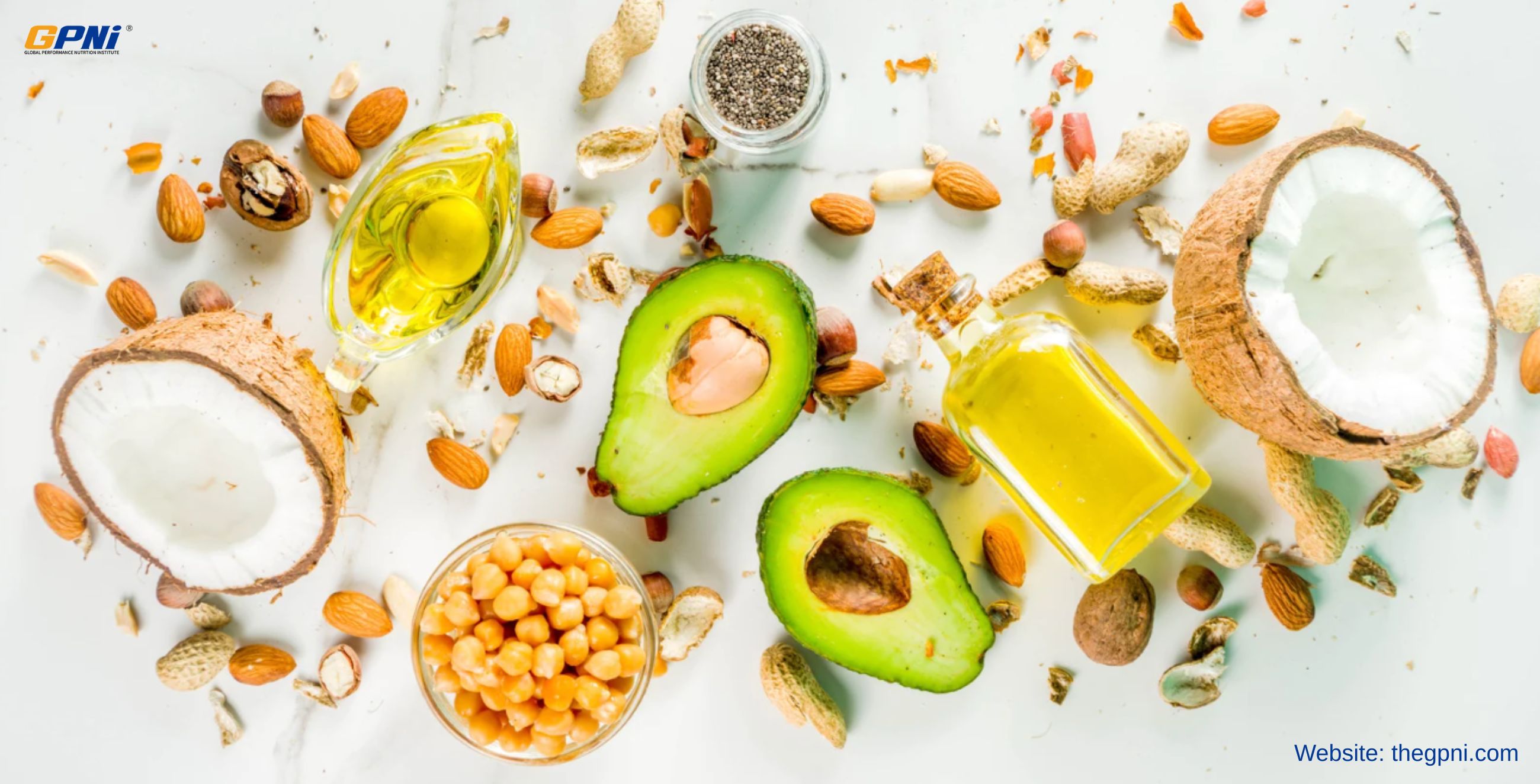
Common food sources include:
- extra-virgin olive oil,
- avocado,
- many nuts,
- peanuts,
- and some seeds.
Controlled feeding research shows that replacing saturated fat with monounsaturated fat can reduce LDL cholesterol.
Polyunsaturated fats
Polyunsaturated fatty acids, or PUFAs, contain multiple double bonds and include the omega-6 and omega-3 fatty-acid families.
Food sources include:
- walnuts,
- seeds,
- many vegetable oils,
- oily fish,
- and other seafood.
Humans also require certain polyunsaturated fatty acids from the diet because they cannot be synthesized in sufficient quantities. WHO specifically identifies linoleic acid and alpha-linolenic acid as essential dietary fatty acids.
From a practical health perspective, there is little value in turning MUFA versus PUFA into another nutrition rivalry. Both can contribute to a high-quality diet, and both can be useful replacements for saturated fat. The most relevant comparison is often not olive oil versus walnuts, but rather olive oil or walnuts versus a dietary pattern dominated by butter, high-saturated-fat foods and industrial trans fats.
Food Matters, Not Just Fatty-Acid Percentages
One of the limitations of reducing nutrition to individual nutrients is that people do not eat isolated fatty acids.
They eat foods.
Extra-virgin olive oil contains mostly monounsaturated fat. Nuts provide unsaturated fats alongside protein, fibre, minerals and other bioactive compounds. Oily fish provides long-chain omega-3 fatty acids as part of a protein-rich food.
This helps explain why dietary pattern matters.
In the PREDIMED trial, 7,447 adults at high cardiovascular risk were assigned to a Mediterranean dietary pattern supplemented with either extra-virgin olive oil or mixed nuts, or to a control diet. The revised analysis reported a lower incidence of major cardiovascular events in both Mediterranean-diet groups compared with the control group. The trial had documented protocol deviations, which is why the revised analysis should be interpreted in that context, but it remains important evidence that a dietary pattern rich in foods containing unsaturated fats can support cardiovascular health.
The lesson is not that olive oil or nuts are magic.
It is that fat quality sits inside overall diet quality.
What Does This Mean for Athletes?
For athletes, dietary fat sometimes receives less attention than carbohydrate and protein.
That makes sense to a degree. Carbohydrate availability can have a major influence on high-intensity endurance and training performance, while protein receives considerable attention for muscle protein synthesis, adaptation and recovery.
But fat still has essential roles.
Sports nutrition guidance emphasizes that well-chosen nutrition strategies need to support both performance and health, rather than focusing on a single macronutrient in isolation.
For athletes, adequate dietary fat contributes to:
- overall energy intake,
- provision of essential fatty acids,
- absorption of fat-soluble vitamins,
- and a sustainable dietary pattern that supports long-term health.
This is particularly relevant when an athlete is deliberately restricting energy intake or attempting to reduce body fat. Cutting dietary fat extremely low simply because “fat contains more calories” may produce a diet that looks mathematically efficient but is nutritionally poorly designed.
Performance nutrition is not about making one macronutrient as low as possible.
It is about allocating energy and nutrients according to the athlete's training demands, body-composition goals, health status and competition schedule.
Where Should Unsaturated Fats Fit Around Training?
There is also an important distinction between a healthy food and the right food at the right time.
Foods such as nuts, avocado and olive oil can be excellent parts of an athlete's overall diet. But a very high-fat meal immediately before intense training or competition may not always be the most practical choice, particularly for athletes who experience gastrointestinal discomfort.
In that situation, the question is not whether unsaturated fat suddenly becomes “unhealthy.”
The question is whether the meal matches the performance context.
An athlete might therefore emphasize carbohydrate and moderate protein close to a demanding session while obtaining much of their dietary fat at other meals.
That is a classic performance-nutrition principle:
Good nutrition requires both food quality and appropriate timing.
A Practical Fat Upgrade
Rather than attempting to eliminate dietary fat, consider making substitutions.
Instead of automatically asking:
“How can I eat less fat?”
ask:
“Where is most of my fat coming from?”
Useful changes may include replacing some butter or high-saturated-fat spreads with olive or canola oil, choosing nuts or seeds as part of meals and snacks, regularly including appropriate sources of oily fish, and keeping industrial trans-fat intake as low as possible. WHO similarly recommends shifting dietary fat away from saturated and trans fats toward unsaturated sources.
This approach is more meaningful than judging a diet from the total grams of fat alone.
The Bottom Line
So, what is the healthiest type of fat?
Unsaturated fat is the best general answer.
But the reasoning deserves more depth than:
“because it is liquid at room temperature.”
Many unsaturated fats are liquid because of their molecular structure. That helps us identify them, but it does not explain their health effects.
The stronger evidence-based explanation is that replacing saturated and trans fats with unsaturated fats can improve blood lipid profiles and form part of dietary patterns associated with better cardiovascular outcomes.
For athletes, the principle goes one step further.
Do not simply pursue a “low-fat” diet.
Aim for the right amount, the right sources and the right timing—within a dietary pattern that supports both performance today and health over the course of a career.
References
- World Health Organization. Saturated fatty acid and trans-fatty acid intake for adults and children: WHO guideline. 2023.
- World Health Organization. Healthy Diet. 2026.
- Hodson L, Skeaff CM, Chisholm WA. Eur J Clin Nutr. 2001;55:908–915.
- Gaundal L, et al. Br J Nutr. 2021;125:915–925.
- Estruch R, et al. N Engl J Med. 2018;378.
- Thomas DT, Erdman KA, Burke LM. Med Sci Sports Exerc. 2016;48:543–568.













 Instagram
 Facebook
 YouTube
 Twitter
 Linkedin