
Continuing education credits have become an important part of modern professional life. In simple terms, they reflect an adult’s ongoing effort to learn, practice, update skills, and broaden both knowledge and perspective throughout their career.
There are many ways to earn continuing education credits. Common options include attending training courses, learning new skills, or taking professional certification exams. Among these, certification exams are one of the most recognized ways to demonstrate professional competence in a specific field. Earning a certification not only validates your knowledge and ability, but can also strengthen your competitive edge in the job market. In many cases, a recognized credential carries more weight and authority than attending a short course or studying alone.
Continuing education also plays an important role in both career development and personal growth. In some professions, it may even be a key factor in promotion, salary increases, or hiring decisions. That is why more and more professionals are taking continuing education seriously.
At GPNi®, we are equally committed to supporting sports nutrition professionals through a clear continuing education credit policy. In fact, at GPNi®, the CEC program is just as important as the certification itself. Below, we take a closer look at GPNi’s continuing education policy and why earning and renewing these credits matters.
What Are Continuing Education Credits?
Continuing Education Credits (CEC), also referred to as Continuing Education Units (CEU), were established in 1970 by the U.S. Department of Education and the International Accreditors for Continuing Education and Training (IACET). Their purpose is to help adults improve professional knowledge and skills throughout their working lives. CECs are also widely used as a way for professionals to maintain their licenses or certifications, since many industries require ongoing learning and professional development.
CEC value is generally assigned based on the quality and duration of an educational activity, such as a course, seminar, examination, or advanced training program. Programs that include some form of assessment of the knowledge or skills acquired often carry more CEC value. In practical terms, CEC-based education packages the latest knowledge and best practices into structured learning experiences, allowing professionals to save time, stay current, and earn credits at the same time.
Much like a university degree or certificate, CECs can help professionals demonstrate to current or prospective employers that they have relevant skills and are keeping up with developments in their field. Continuing education matters just as much as certification itself. Whether you work as a personal trainer or a sports nutrition professional, staying current with the latest research is essential. Calling yourself a professional is not only about credibility; it is also about client safety and professional responsibility.
Who Needs Continuing Education Credits?
Professionals who hold a nationally issued license or a recognized professional certification are often required to complete a certain number of CECs on a regular basis in order to renew their credentials. Many industries, including healthcare, fitness and wellness, accounting, engineering, and education, require continuing education so that practitioners can stay aligned with best practices and maintain their professional standing.
The number of credits required usually depends on two factors: the profession itself and the country or region in which the individual works. Requirements vary, but professionals can usually seek guidance directly from the organization that provides or oversees the credits.

Why Do Continuing Education Credits Matter?
Maintaining Professional Standards
CEC requirements are designed for professionals who have already reached a certain educational standard and need ongoing learning each year to keep their license or certification current. This helps ensure they remain informed about the latest practices in their field. For fitness professionals and sports nutrition practitioners, best practice, up-to-date science, and duty of care are all fundamental when working with clients on health and performance.
Strengthening Competitiveness
CEC can also improve your professional value in the market. Because continuing education programs often provide highly relevant, career-specific training, employers recognize their importance. A candidate with stronger expertise in sports nutrition is often more attractive for hiring and promotion.
Increasing Value Across Markets
The amount and quality of education you complete often have a direct relationship with earning potential. The more valuable skills you bring to the table, the more competitive you become in the job market. For example, for a personal trainer, having expertise in nutrition in addition to training can significantly increase professional value.
Building Professional Networks
Continuing education is also a valuable opportunity to connect with other professionals in the field. Shared learning environments allow participants to build relationships, exchange ideas, and expand their professional network within sports nutrition.
Academic Recognition
Most universities do not directly accept CECs as equivalent to university credits. However, some institutions may consider a combination of work experience and continuing education when evaluating a candidate’s background.
GPNi’s Continuing Education Credit Policy
The importance of CECs is clear. Yet globally, many fitness certification organizations pay surprisingly little attention to the quality and responsibility of their continuing education programs. Within the industry, it is widely known that only around 2–5% of certified coaches actually renew their CECs, which is alarmingly low.
At the GPNi® Performance Nutrition Academy, we place far greater importance on this area than many other international certification programs. At GPNi®, the CEC program is every bit as important as the certification itself. Trainers who do not meet the CEC requirements will be marked on their profile as “inactive.” This gives clients of GPNi® and ISSN-certified practitioners greater confidence that the professional they work with is both qualified and up to date with the latest knowledge in nutrition.
For both GPNi® and ISSN-certified professionals, continued professional development includes the completion of 10 continuing education credits every two years in order to maintain active registration status.

The CEC Policy for ISSN-SNS and CISSN Certifications
The ISSN-SNS credential stands for Sports Nutrition Specialist, awarded by the International Society of Sports Nutrition (ISSN). It is designed for personal trainers and other fitness professionals who do not hold a related four-year college or university degree. It serves as an entry-level sports nutrition certification and can also be an excellent stepping stone toward the more advanced CISSN credential.
The CISSN designation refers to the Certified Sports Nutritionist credential from ISSN. It is currently one of the only certifications on the market dedicated specifically to sports nutrition.
It is important to note that both the ISSN-SNS and CISSN certifications are valid for two years. During that two-year period, you must complete 10 CECs in order to keep the certification active.
How to Renew Your GPNi Continuing Education Credits
There are several ways to earn or renew your CEUs. Full details can be found in the CEC table below, but the main options include:
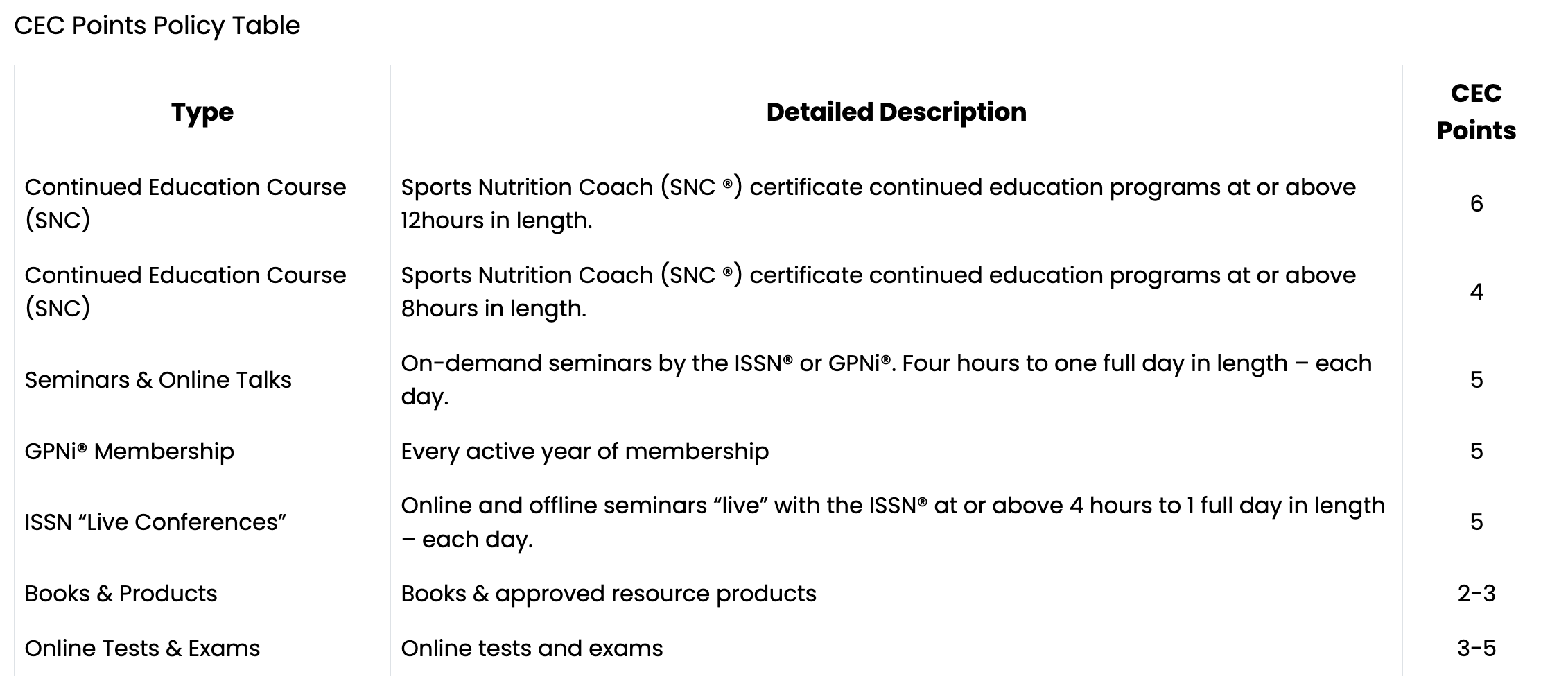
As a global leader in sports nutrition education, the GPNi® Performance Nutrition Academy is committed to raising industry standards and supporting continuous professional development. Continuing education helps advance your career by strengthening the skills you already have while also helping you build new ones.
For more details on GPNi’s continuing education credit policy, please visit:
https://thegpni.com/our-policies














 Instagram
 Facebook
 YouTube
 Twitter
 Linkedin