Why This Story Matters More Than It Looks
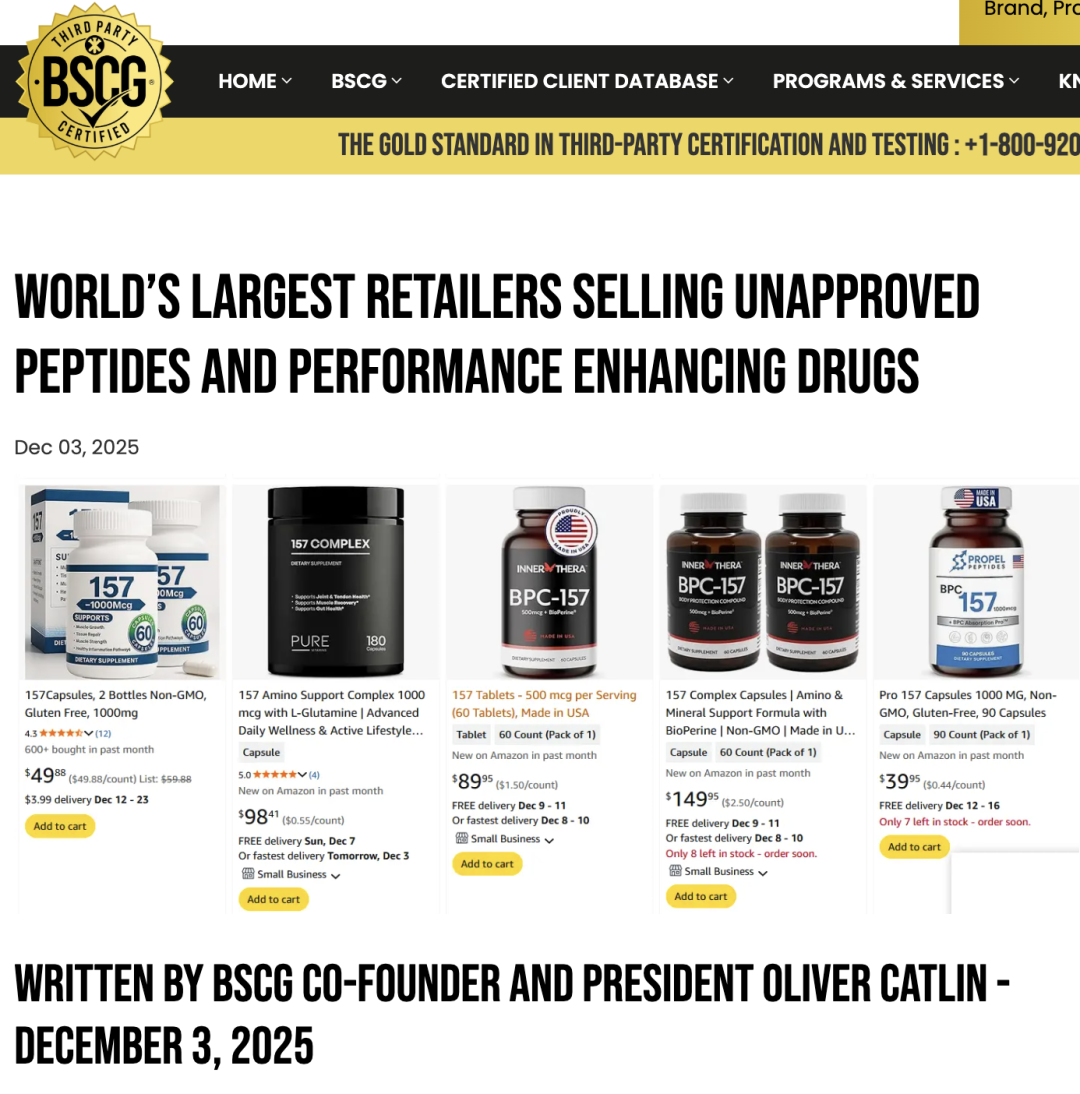
“Coach, I found BPC-157 on Amazon. Next-day delivery. If it’s on there, it has to be safe… right?”
If you work with athletes long enough, you’ll hear some version of that sentence.
A recent article from the Banned Substances Control Group (BSCG), titled “World’s Largest Retailers Selling Unapproved Peptides and Performance Enhancing Drugs,” makes it clear this isn’t paranoia or locker-room gossip. Major online platforms have been selling unapproved peptides and performance-enhancing drugs (PEDs) to anyone with a credit card.
From a GPNi® perspective, this hits three sensitive nerves at once:
- Health and safety
- Anti-doping and fair play
- The long-term credibility of sports nutrition as a profession
Let’s walk through what’s happening and then cover what coaches, athletes, and practitioners can realistically do.
What BSCG Found: “Research Chemicals” in Normal-Looking Listings

BSCG’s team searched large marketplaces the same way a regular consumer would. What they found was uncomfortable:
- Peptides such as BPC-157, AOD-9604, MOTS-c, TB-500, Tesamorelin, Sermorelin, Ipamorelin, and others listed on major retail platforms.
- Available in powders, capsules, liquids, nasal sprays, and even injectable vials.
- Many appear to be investigational compounds not approved medicines, and not lawful dietary supplements under U.S. DSHEA or similar rules elsewhere.
To make these products look more “normal,” sellers often describe them as:
- “research chemicals”
- “lab reagents”
- “daily chemicals”
- or tuck them into supplement categories with polished branding and influencer-friendly labels
On the surface, it looks like any other product Prime shipping, user reviews, professional photos. But underneath, you’re dealing with compounds that often sit in a legal and medical grey zone and frequently overlap with the WADA Prohibited List.
BSCG also highlights an important pattern: media attention pushes some listings offline, but new ones keep reappearing under slightly different names or packaging.
This is the same cycle the supplement industry saw with prohormones and designer stimulants just with a new class of compounds.
Are These “Just Supplements”? No.

BPC-157 is a perfect example of how confusing this looks from the outside. It is often marketed as a “healing peptide” or “gut peptide.” However:
- It was developed as a drug candidate
- It was never approved for human clinical use by regulatory authorities
- It is prohibited by WADA under the category of S0 Unapproved Substances
USADA has also warned athletes that there is no legal basis for selling BPC-157 as a dietary supplement or approved drug, and that safety and dosing remain unclear due to limited human research.
AOD-9604 is another example. It is a fragment of growth hormone originally explored as a fat loss drug. It now appears in online products marketed as “fat burning,” despite its regulatory status and banned substance concerns.
And newer names like MOTS-c or TB-500 may sound sophisticated, but come with little long-term human safety data.
From a GPNi® perspective, the line is simple:
If a compound is an investigational drug, appears on the WADA list, or exists mainly in “research chemical” catalogues, it is not a sports supplement no matter how clean the label looks.
You can be curious as a scientist and still recognise that curiosity is not a green light for day-to-day practice.
Why This Is Risky for Athletes and Coaches

For tested athletes, the risk stacks up quickly:
1) Doping Risk
Many peptides fall under prohibited categories. A click today can become a violation later even if the athlete insists they didn’t know.
2) Product Quality Risk
Because these are not lawful supplements or approved medicines, quality control is a guess at best. You may not know:
- the true dose
- the purity
- contamination risks
- or what else is in the vial
This is a classic “unknown unknowns” problem.
3) Health Risk
Animal data and early mechanistic claims may look exciting, but large human trials are missing for many peptides. Long-term effects, drug interactions, endocrine disruption, and cancer-risk pathways remain poorly understood.
For coaches and practitioners, there’s another risk:
Once you “look the other way” on something this far outside the evidence base, it becomes much harder to position yourself as a trusted, science-driven professional.
At GPNi®, we see it like this:
- If you recommend a peptide that later shows serious safety issues, that responsibility lands on you.
- If your athlete tests positive for a WADA-banned molecule they bought online, you may not be legally responsible, but you will still be part of the story.
Neither outcome is acceptable for professionals who care about credibility.
How GPNi® Suggests You Respond in Practice
Instead of simply saying “don’t do it” and walking away, here are practical strategies you can actually use.

1) Draw a Clear, Simple Boundary
When an athlete shows you a peptide listing, keep your response calm and direct:
“This isn’t a supplement. It’s an unapproved drug sold as a research chemical.
It’s very likely banned in your sport, and we don’t know the real safety profile.
That’s not something I can support or program around.”
Short, honest, no drama.
2) Re-Center the Discussion on What Works
Experimental peptides often appeal most when someone is injured, stuck, or anxious about selection. That’s when fundamentals matter even more:
- Structured training and smart load management
- Adequate energy availability
- Sufficient protein, carbohydrates, and micronutrients
- Legal, well-studied supplements with third-party certification such as creatine, caffeine (where appropriate), and beta-alanine in certain sports
From a performance standpoint, these are still more predictable and safer than any experimental peptide bought from an anonymous storefront.
3) Lean on Third-Party Testing and Clean Sourcing
Given how messy the marketplace has become, athletes and teams should:
- Prefer products certified by trusted third-party testing programs like BSCG or Informed Sport
- Avoid brands that flirt with peptides or grey-market drug products while claiming to be “clean”
- Treat sourcing standards as non-negotiable
If a company wants to operate in elite sport, it must stay out of the research-chemical game. That is a reasonable standard.
Where GPNi® Stands
GPNi® is not anti-research and not anti-medicine. Some peptides may eventually become properly regulated treatments in defined clinical contexts.
But until that happens, our stance is simple:
Coaches, practitioners, and athletes who care about clean sport should not treat unapproved peptides as just another “advanced recovery tool.”
The fact that something appears on a major retailer:
- does not make it safe
- does not make it legal in sport
- and does not make it good practice
If anything, this situation reminds us why sports nutrition must stay grounded in:
- real data
- transparent sourcing
- third-party testing
- and respect for anti-doping rules beyond “can I get away with it?”
That is the standard we teach inside GPNi®, and it’s the standard the industry will eventually be forced to adopt hopefully by choice, not by scandal.
References
Catlin O. World’s Largest Retailers Selling Unapproved Peptides and Performance Enhancing Drugs. Banned Substances Control Group (BSCG) Blog. December 3, 2025.
Banned Substances Control Group (BSCG). The Gold Standard in Third-Party Certification & Testing.
StudyFinds / The Conversation. Peptides: Performance-Boosting, Anti-Aging Drugs Or Dangerous Snake Oil? August 2025.
Informed Sport. Sports Supplements Certification.
British Society of Criminology. Peptides: Substances of Tomorrow. Moving Beyond the Traditional Distinction Between Medicinal Use and Enhancement.
This commentary reflects GPNi®’s interpretation of current evidence and regulatory context as of December 2025 and is intended for educational purposes. It is not medical or legal advice.











 Instagram
 Facebook
 YouTube
 Twitter
 Linkedin