
In sport nutrition, the same question can often lead to two completely opposite answers online — and both may sound convincing.
That is why many common mistakes in sport nutrition are not caused by a lack of information. They happen because people learn isolated conclusions without learning how to judge the evidence behind them.
Here are five sport nutrition questions to test how well you really understand the basics.
Q1: Do you have to consume protein within 30 minutes after training?
Q2: Should you eat carbohydrates during fat loss? If yes, when?
Q3: Do you need to take BCAAs separately?
Q4: Who should consider creatine, and for which types of sport?
Q5: How should you choose a pre-workout supplement?
1. Do You Have to Consume Protein Within 30 Minutes After Training?
Common misconception:
If you miss the “golden 30-minute window,” your workout is wasted.
Evidence-based explanation:
The so-called anabolic window does exist in the sense that, after training, the body is more receptive to nutrients that support repair, recovery, and muscle protein synthesis. However, this window is not as short or as strict as many people believe.
For most active individuals, consuming protein and carbohydrates after training can be helpful, especially within the first few hours. But muscle protein synthesis remains elevated for several hours after exercise. What matters most is not whether you drink a shake within exactly 30 minutes, but whether your total daily protein and energy intake are sufficient.
Practical recommendations:
First, meet your daily protein target before worrying about timing.
Aim to have a meal or supplement containing both protein and carbohydrates within 1–2 hours after training.
If you trained after a long fasting period or had an inconsistent eating day, a post-workout whey protein shake may be more useful.
2. Should You Eat Carbohydrates During Fat Loss? If Yes, When?
Common misconception:
Fat loss means going zero-carb.
Evidence-based explanation:
Fat loss depends primarily on maintaining an appropriate calorie deficit. Carbohydrates are not automatically “bad” for fat loss. In fact, they can directly influence training quality, recovery, mood, and overall adherence.
Cutting carbohydrates too aggressively may lead to poor workout performance, slower recovery, lower daily activity levels, stronger cravings, and rebound overeating. A smarter strategy is not to eliminate carbohydrates, but to choose better sources and place them where they are most useful.
Practical recommendations:
Prioritize complex carbohydrates such as rice, oats, potatoes, whole grains, and other minimally processed sources.
Limit simple sugars from candy, sugary drinks, pastries, and highly processed snacks.
Place more carbohydrates around training — before training to support performance, and after training to support recovery.
Eat more carbohydrates on high-intensity training days, and reduce them on rest days or low-intensity days.

3. Do You Need to Take BCAAs Separately?
Common misconception:
BCAAs are essential for muscle growth, and you must drink them during every workout to prevent muscle breakdown.
Evidence-based explanation:
BCAAs — leucine, isoleucine, and valine — are involved in muscle protein metabolism. Leucine, in particular, plays an important role in stimulating muscle protein synthesis.
However, for most people who already consume enough high-quality protein, separate BCAA supplementation usually offers limited additional benefit. If your total daily protein intake is sufficient, especially around or above approximately 1.6 g/kg/day, you are likely already getting enough BCAAs from complete protein sources.
BCAAs may be more relevant in specific situations, such as fasted training, low-protein diets, or long-duration endurance exercise. Even then, they should not replace complete protein.
Practical recommendations:
Focus first on total daily protein intake and distribute protein across multiple meals.
If your budget is limited, prioritize high-quality foods or whey protein before buying BCAAs.
Choose complete protein sources such as whey protein, eggs, meat, fish, dairy, soy, or other high-quality proteins. These already contain BCAAs.
4. Who Should Consider Creatine, and for Which Types of Sport?
Common misconception:
Creatine is either a “magic muscle-building supplement” or something that damages the kidneys.
Evidence-based explanation:
Creatine is one of the most extensively studied sport supplements, with relatively consistent evidence supporting its benefits in high-intensity performance.
Creatine mainly supports short-duration, high-intensity efforts, such as strength training, explosive power, repeated sprints, and interval-based performance. By improving the ability to produce energy rapidly, creatine may help athletes increase training volume and performance over time, which can indirectly support muscle growth and strength development.
For healthy individuals using appropriate doses, creatine is generally considered safe. People with kidney disease or medical concerns should consult a healthcare professional before using it.
Practical recommendations:
Creatine is most relevant for strength training, sprinting, team sports, repeated high-intensity intervals, and explosive sports.
Beginners should first build a solid foundation with training, nutrition, and recovery before relying on supplements.
Supplements should always come after the fundamentals: training plan, total energy intake, protein intake, sleep, and recovery.
5. How Should You Choose a Pre-Workout Supplement?
Common misconception:
The stronger the stimulation, the better the pre-workout. More dosage means better results.
Evidence-based explanation:
Pre-workout supplements are usually multi-ingredient formulas. Common ingredients include caffeine, beta-alanine, citrulline, and other performance-related compounds.
However, sensations such as tingling, a racing heartbeat, or feeling “stimulated” do not necessarily mean the product is more effective. Caffeine can support focus and performance, but people vary greatly in their tolerance. It can also affect sleep, anxiety, and recovery if used too late or too often.
Long-term, high-frequency use may also lead to tolerance or dependence, making people mistake poor recovery or low energy for a need for stronger stimulation.
Practical recommendations:
If you are sensitive to caffeine, start with a lower dose and avoid taking it too late in the day.
Begin with half a serving to assess tolerance before using a full serving.
Do not exceed the recommended dosage on the product label.
If you use stimulant-based pre-workouts regularly, consider cycling your use — for example, taking a break after several weeks of consistent use.
From Memorizing Answers to Building Real Judgment
If you only wanted quick answers, the explanations above may be enough.
But the next time you come across a controversial nutrition claim, the real goal is not just to remember one conclusion. The real goal is to understand how to evaluate the evidence, identify context, and apply the right framework.
That is why systematic sport nutrition education matters.
The ISSN-SNS (Sport Nutrition Specialist) Certification is built on current sport nutrition science and emphasizes evidence-based thinking. It helps learners move beyond trends, myths, and social media claims — and start making decisions based on data, mechanisms, and practical frameworks.
Why ISSN-SNS?
The ISSN-SNS certification is an entry-level sport nutrition certification designed for learners who need a structured foundation before progressing to more advanced study.
The course focuses specifically on sport nutrition and is built around evidence-based principles. It is also designed with practical application in mind, making it especially valuable for professionals who want to deepen their understanding of sport nutrition science and stand out in their careers.
Through the ISSN-SNS certification, you can:
Build a complete and systematic foundation in sport nutrition.
Move beyond fragmented information from posts, videos, and isolated lectures.
Understand the full map of sport nutrition instead of memorizing scattered facts.
Prepare for more advanced certifications and future professional development, such as the CISSN.
Who Is ISSN-SNS For?
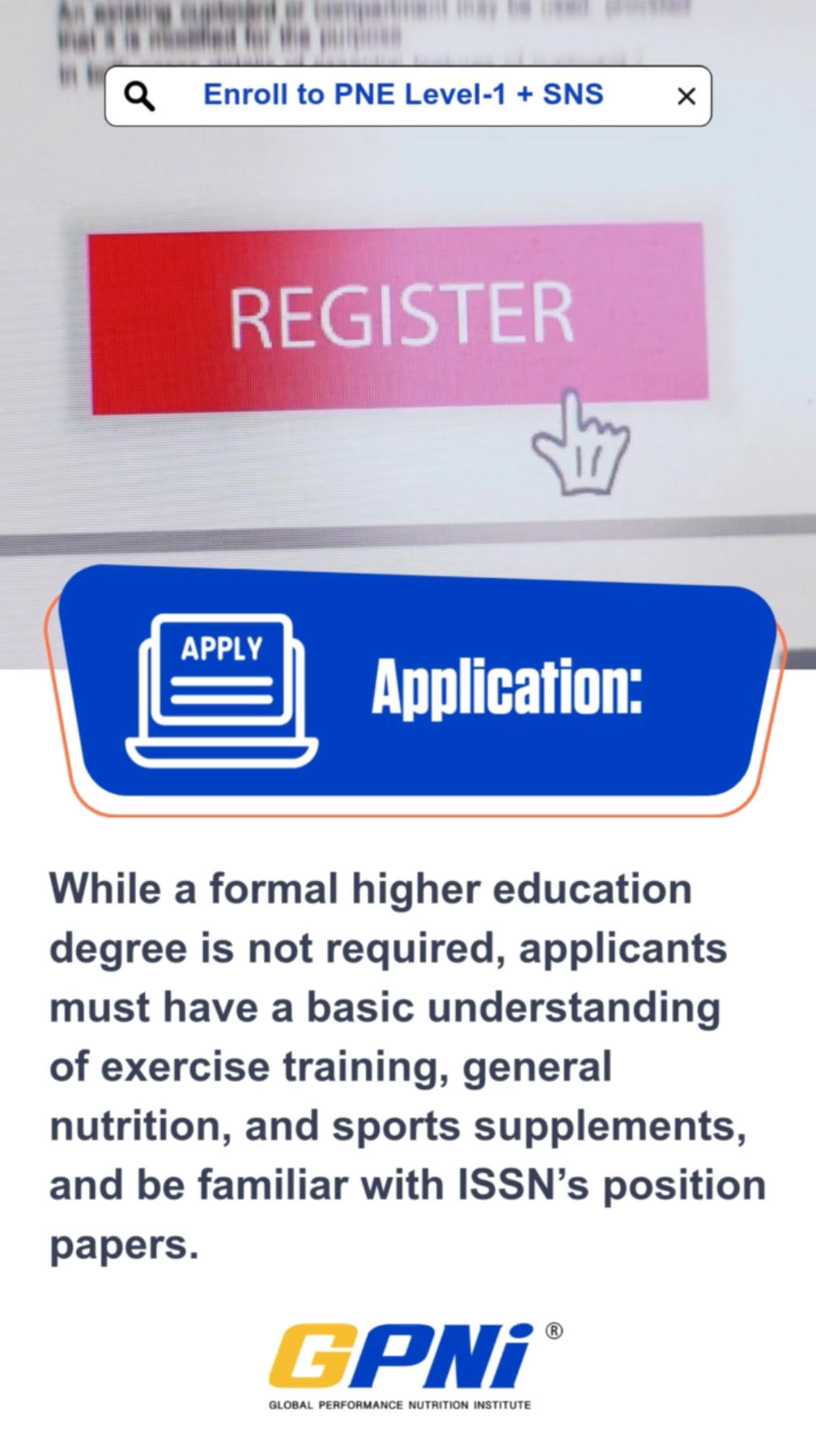
The ISSN-SNS certification is recommended for individuals who already have basic knowledge of exercise training, general nutrition, sport supplements, and ISSN position stands.
It may be especially suitable for:
Personal trainers, online coaches, strength and conditioning coaches, and gym managers who want to advance their professional knowledge.
Undergraduate or graduate students in related fields who want to prepare for a future career in sport nutrition or performance.
Fitness enthusiasts and professionals who are interested in sport nutrition but feel overwhelmed by conflicting information.
If you want an entry-level, evidence-based certification that helps you build a real foundation in sport nutrition, ISSN-SNS is a strong place to start.













 Instagram
 Facebook
 YouTube
 Twitter
 Linkedin